







Yushima Seido of Tokyo, Japan
2024-04-08 15:05:07 来源:新华网
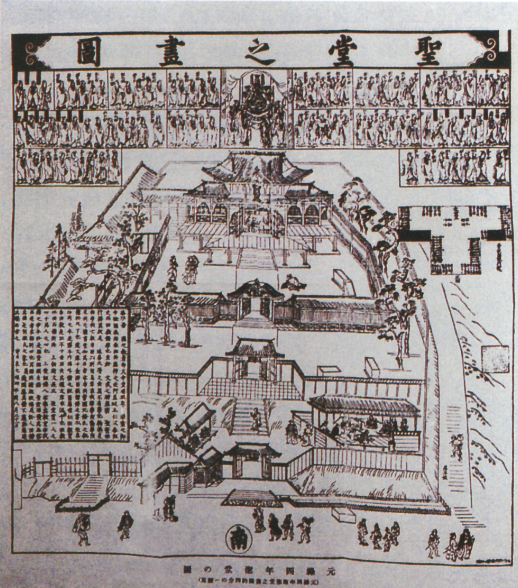
Painting of Yushima Seido(from Great is Confucius, P178)
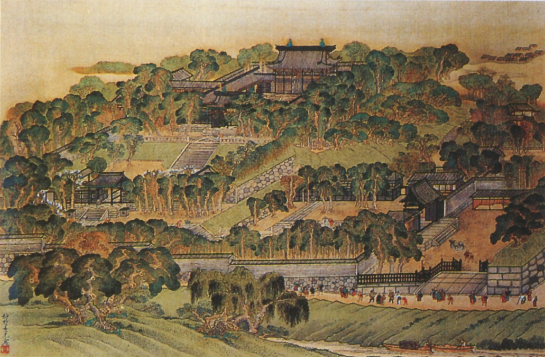
Painting of Yushima Seido(from Great is Confucius, P207)
Around 284 AD, the Baekje envoy from the Korean Peninsula arrived in Japan and introduced the Confucius’ Analects and other Confucian classics. In 676, imitating the style of the Chinese Imperial Academy, an academywas established in Japan. There are more than 30 preserved Confucian temples in Japan,mostly from the Edo period (1603-1867). Most of them,followingthe practices of China after the Song Dynasty, integrate Confucian temples with schools.
Yushima Seido, also known as the Confucius Temple of Tokyo, is a typcial representative of Japanese Confucian temples, where a stone tablet of “birthplace of school education in Japan”was erected.
In the seventh year of the Kan'ei era (1630), the third-generation general Tokugawa Iemitsu ordered Lin Luoshan, who respected the great Confucian Zhu Xi, to establish a temple and school.The Lin family's hereditary instructors educated the children of the shogunate officials with Confucianism. Itwas called the Confucius Templeupon completion of construction. It was originally located in Ueno, where its headmaster, Hayashi Razan, had his residence. It was moved to its present location in 1690 by the fifth Tokugawa shogun, Tsunayoshi, when he made Confucianism the official philosophy of Japan.According to Chinese tradition, the main hallwas renamed "Dacheng Hall" and the surrounding ancillary buildings were called "seido". Afterwards, this temple wasknownas Shoheizaka Gakumonjo and it soon became a premium academyattracting the best students from around the country. In 1872, the Meiji government established the first teacher's training institute here. With time this center of education evolved into Tokyo University.The building was originally modeled after the Chinese style, with red painted pillars and a green appearance. But during this expansion, the building waspainted blackin accordance with therenovation of another Confucius templeelsewhere.
In 1922, the Tang Island Cathedral was designated as a national-level historical site. In the 1923 Kanto earthquake, many parts of the templewere burned down, and the Dacheng Hallwas destroyed. In 1935, reconstruction started. In 1975, the Taipei Lion Club in Taiwan presented the world's largest statue of Confucius as a gift and placed it here. In addition to Confucius, the statues of the four figures of Confucius (YanHui, Zengzi, Kong Jiand Mencius) were also placed here for worship.
Originally in theeast part of Yushima Seidowas the Confucian School and in the west part was the Confucian temple for worship. Nowonly temples now exist. On the fourth Sunday of April every year, a sacrificial ceremony is held. Yushima Seido attracts a lot of worshipers. The place is especially crowded during examination time when students come to pray for success in examinations.
【编辑:董丽娜】
文章、图片版权归原作者所有,如有侵权请联系删除- 关于参与2026中国国际孔子文化节——全球“云祭孔”活动的倡议
- 以构建中国社会学自主知识体系促进文明交流互鉴
- 全过程人民民主是“两个结合”的典范
- 深入理解“坚持制度治党、依规治党”
- 为全球南方聚力 启金砖合作新程——习近平主席赴印度出席金砖国家领导人第十八次会晤,务实高效、定位精准、成果丰富,取得圆满成功
- 坚持健全上下贯通、执行有力的组织体系
- 孔子研究院2026年第二批公开招聘人员公告
- 孔德安︱仁义为基、礼智并举:孔子的勇思想
- 关于参与2026中国国际孔子文化节——全球“云祭孔”活动的倡议
- 黄河流域民间美术的价值意蕴与时代发展
- 以构建中国社会学自主知识体系促进文明交流互鉴
- 全过程人民民主是“两个结合”的典范