

A Rendezvous of Civilizations in the Hometown of Confucius: A Review of the 2026 China International Confucius Cultural Festival and the Nishan Forum on World Civilizations
2026-10-03 17:23:39
On September 28, in Qufu, Shandong, the 2026 China International Confucius Cultural Festival and the 2026 Nishan Forum on World Civilizations were held in succession. The Confucius Cultural Festival invited approximately 300 guests from 42 countries and regions, while the Nishan Forum brought together around 340 participants from 44 countries and regions, all gathering for a civilizational rendezvous that transcends mountains and seas.
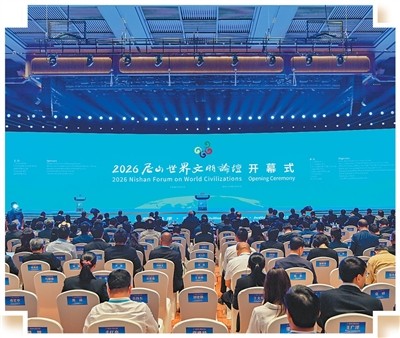
The opening ceremony of the 2026 Nishan Forum on World Civilizations. Photo by Xiao Jiaxin, People's Daily
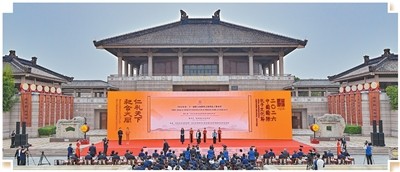
The opening ceremony of the 2026 China International Confucius Cultural Festival. Photo by Xiao Jiaxin, People's Daily
At the opening ceremony of the China International Confucius Cultural Festival, the awarding ceremony for the 21st UNESCO Confucius Prize for Literacy was held, with three educational projects from Lebanon, Mexico, and Thailand receiving the honor.Established in 2005, the prize continues to promote Confucius' educational philosophy of "education without discrimination" worldwide. The event also featured presentations on the "Study Tours with Confucius" initiative and the launch of "Canal No. 1," alongside the inauguration of a cultural tourism carnival. Following the opening ceremony, the Confucius Memorial Ceremony took place at the Confucius Temple, preserving traditional rituals including the opening of the city gates, temple gates, and household doors, as well as musical and dance offerings and the reading of sacrificial addresses. The ceremony was linked with Confucian temples and academies across regions, enabling audiences to appreciate the culture of rites and music online beyond geographical boundaries.
Centered on the theme of “Benevolence and Rites for the World, Harmony and Great Unity,” this year’s China International Confucius Cultural Festival is co-hosted by the People’s Government of Shandong Province, the Ministry of Culture and Tourism, and the Chinese National Commission for UNESCO, and will run until October 7. Prior to the opening ceremony, a series of public events had already been launched: 13 outstanding traditional music ensembles from cities along the Grand Canal gathered at the Liaohe Grand Theatre in Jining, Shandong Province, to perform, followed by flash-mob tours at the Wanren Palace Wall in Qufu’s Ming Ancient City and at Nishan Sacred Realm. Meanwhile, the Confucius Cultural Temple Fair on Wuma Temple Street in Qufu’s Ming Ancient City kicked off with a Confucian-style market, lion dances, and stilt performances. Last year’s festival introduced five themed study-tour products, attracting over ten million visitors in total. This year, immersive courses such as the Nishan Teacher-Respecting Ceremony and the Six Arts Workshop have been launched, making the Confucian experience tangible and accessible.
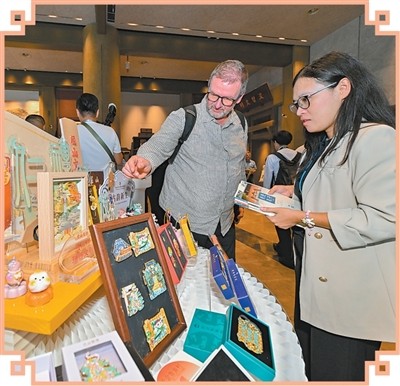
Attendees in cultural and creative products exhibition area to explore distinctive merchandise. Photo by Yang Guoqing
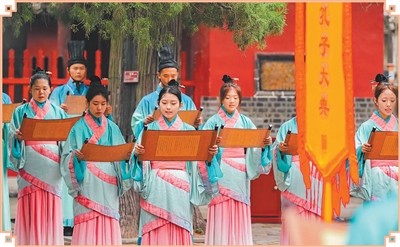
Young people in traditional attire reciting Confucian classics at the Qufu Confucius Temple. Photo by Yang Guoqing
On the afternoon of September 28, the opening ceremony of the 2026 Nishan Forum on World Civilizations was held. Since its inception in 2010, the forum has been successfully convened for 11 editions. This year, it is jointly organized by the People’s Government of Shandong Province, the Ministry of Culture and Tourism, the Overseas Chinese Affairs Office of the State Council, the Chinese Academy of Social Sciences, and the International Confucian Association. On the afternoon of September 28, the opening ceremony of the 2026 Nishan Forum on World Civilizations was held. Since its inception in 2010, the forum has been successfully convened for 11 editions. This year, it is jointly organized by the People’s Government of Shandong Province, the Ministry of Culture and Tourism, the Overseas Chinese Affairs Office of the State Council, the Chinese Academy of Social Sciences, and the International Confucian Association. Under the theme “Civilization, Order, and Justice,” the forum features four sub-themes: the contemporary value and global significance of Confucianism; civilizational resilience and global governance; intellectual dialogue and civilizational integration; and artificial intelligence and universal harmony.
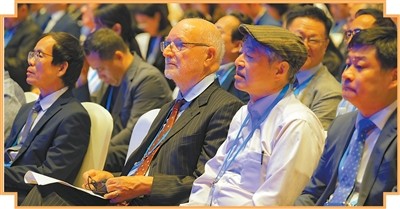
Attendees listening attentively at the Nishan Forum on World Civilizations. Photo by Yang Guoqing
Jin Minqing, member of the Party leadership group of the Chinese Academy of Social Sciences and director of the Institute of Contemporary China Studies, elaborated on three key concepts—civilization, order, and justice: "The essence of 'propriety' lies in the regulation of order. The contemporary world faces deficits in peace, development, security, and governance; we should uphold the global governance principle of extensive consultation, joint contribution, and shared benefits, so that civilizational order can serve as a solid guarantee for safeguarding world peace and stability."
Thomas Bach, Honorary Life President of the International Olympic Committee, highlighted the common ground between Confucian thought and the Olympic philosophy in his video address: "Confucius placed great emphasis on the all-round development of individuals, both physically and mentally. The ancient Romans also expressed a similar idea — a sound mind in a sound body — which lies precisely at the core of the Olympic spirit."
During the subsequent keynote speeches, Chen Lai, a senior professor of humanities at Tsinghua University, distinguished between the narrow and broad senses of civilizational dialogue and called for advancing shared civilizational prosperity through dialogue. Dipak Kumar, a professor at Jawaharlal Nehru University, pointed out that translation serves not only as a bridge between civilizations but also as a process of their joint creation, noting that the ancient translation of Buddhist scriptures between India and China constituted a sustained project of knowledge production. Edmond Mukala, the representative of UNESCO in Ghana, proposed that global governance should be refined by drawing on the principles of "benevolence, righteousness, and harmony" inherent to Chinese civilization; furthermore, global governance should shift from "global control" to "global coordination," and that "cultural identity is not an obstacle to development; on the contrary, it is the very source of momentum for sustainable development."
On the morning of September 29, the forum also held eight panel discussions and two high-level interviews, alongside three parallel forums: the "Cultural China · Nishan World Chinese Community Forum," the "Sports Culture Forum," and the "Confucian Business Culture Forum." In the afternoon, the second keynote speech and the closing ceremony were held, during which the Consensus of the 2026 Nishan Forum on World Civilizations was released.
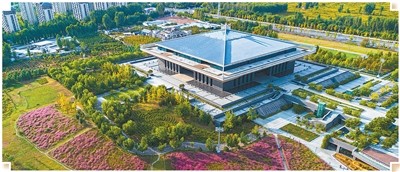
Confucius Museum in Qufu, Shandong Province. Photo by Xue Gang (Image China)
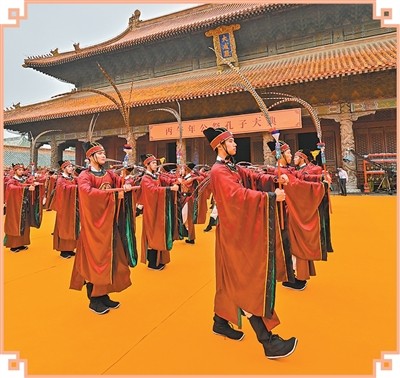
Young people performing in ancient ceremonial attire in front of the Dacheng Hall at the Qufu Confucius Temple. Photo by Yang Guoqing
From the intellectual exchanges at the China International Confucius Cultural Festival to the vibrant clash of ideas at the Nishan Forum on World Civilizations, this cross-continental engagement of civilizations is not only a tribute to ancient sages but also a reflection on humanity’s shared future. Confucian wisdom, such as “benevolence and love for others ” and “do not impose on others what you do not desire,” offers the international community a distinctive Eastern perspective.
Edit:张晓芮
The copyright of the article and the picture belongs to the original author. If there is any infringement, please contact to delete it