







Protecting Yungang Grottoes in focus
2026-03-04 15:54:20 来源:China Daily
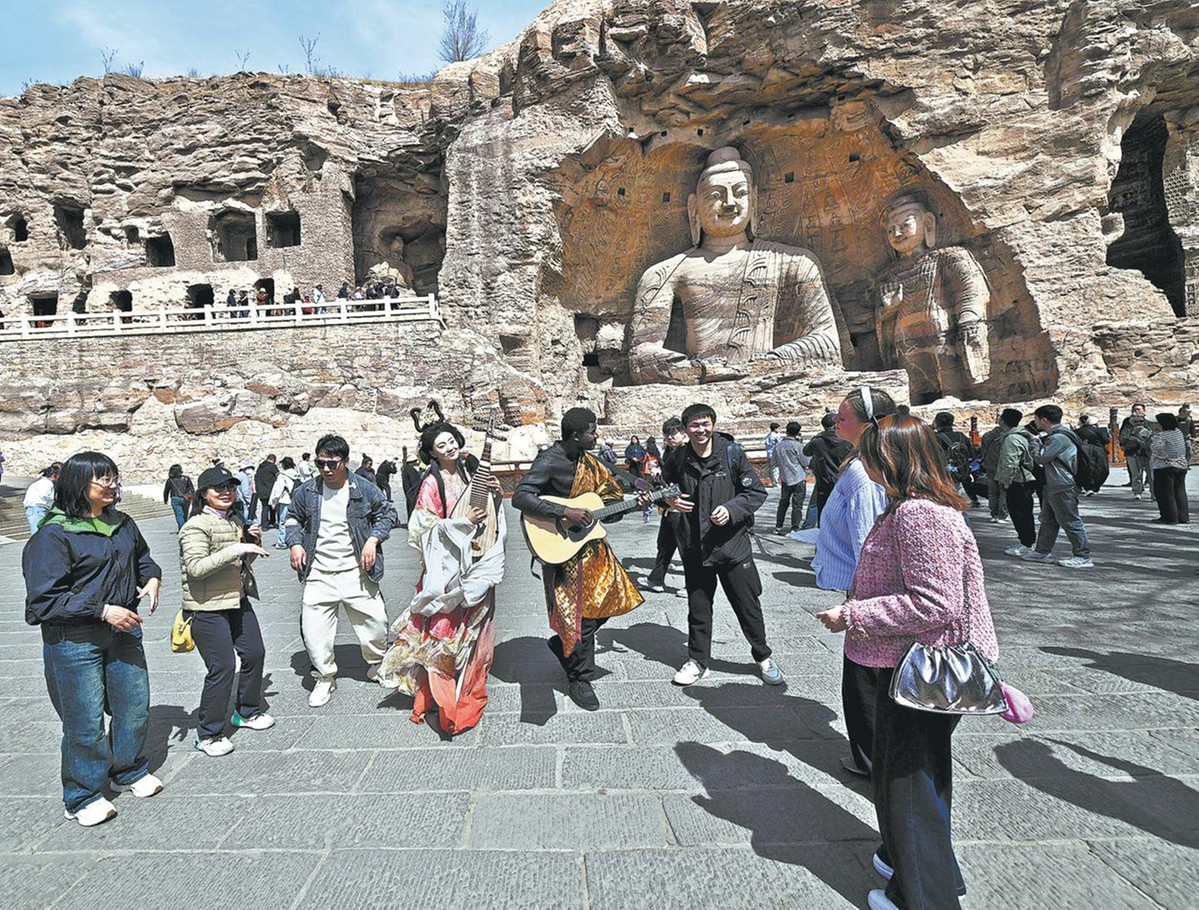
Visitors enjoy their stay at the Yungang Grottoes in Datong city, Shanxi province. ZHAN YAN/XINHUA
Due to China's 240-hour visa-free transit policy for travelers from more than 50 countries, the Yungang Grottoes, a UNESCO World Heritage Site located in Datong, Shanxi province, is attracting an increasing number of foreign tourists.
With the annual session of the National People's Congress approaching, Hang Kan, a Shanxi province deputy to the 14th NPC and director of the Yungang Research Institute, expressed in an interview with China Daily that he plans to propose the construction of regional archaeological artifact storage facilities based on national conditions to coordinate resources and concentrate protection, addressing the challenges of artifact storage at the grassroots level.
"Currently, China's archaeological achievements are becoming increasingly abundant, but the construction of artifact storage facilities is lagging behind," he said.
"The preservation conditions of small and medium-sized museums are inadequate."
The Yungang Grottoes were built during the Northern Wei Dynasty (386-534).
Recognized for extraordinary artistic and historical significance, the Yungang Grottoes were declared a UNESCO World Heritage Site in 2001.
In 2025, the Yungang Grottoes saw a record-breaking 5.28 million visitors, a year-on-year increase of 18.87 percent.
However, the surge in both domestic and international tourists, along with climate change, has brought dual pressures on the preservation of the grottoes' artifacts.
"To tackle preservation challenges, local authorities are advancing the Digital Yungang project, using technologies such as 3D laser scanning and hyperspectral imaging to solve the challenges of data collection for high-relief sculpture," said Hang.
"Through 3D printing technology, an exact replica of Cave 12 — the Music Grotto — has been created and exhibited in different regions across the country, allowing the public to gain a preliminary understanding of the ancient heritage even without visiting the site."
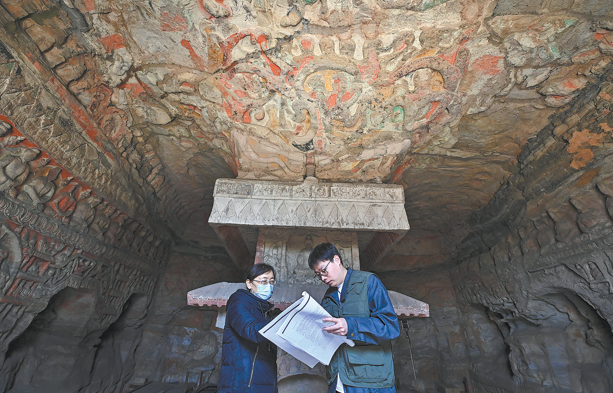
Researchers from the Yungang Research Institute work in one of Yungang's 254 caves. YANG CHENGUANG/XINHUA
According to Hang, balancing openness with protection has become a core issue for Yungang.
"The Yungang Grottoes face significant pressure," he said. "Aside from climate change, the pressure from visitor numbers during peak seasons is too high."
He emphasized the need to scientifically regulate visitor flow while ensuring the safety of the artifacts.
"By adjusting the pace of visits based on seasonal differences and making the off-season draw more visitors, we have seen some changes," he said.
As one of China's four major grotto art treasures, the Yungang Grottoes stretch about one kilometer from east to west, with 254 caves and over 59,000 statues.
"The Yungang Grottoes are considered as the pinnacle of Chinese grotto art in the 5th century," he said. "They integrate architecture, sculpture, painting, and calligraphy, preserving a complete historical space and cultural context."
With the significant increase in foreign tourists, the Yungang Research Institute has also strengthened its international service capabilities.
"We have specifically recruited foreign language talent to cater to foreign visitors," he said.
"The institute has also developed online interactive projects to explain the origins of the carving art to people from different cultural backgrounds."
He also expressed his greatest hope that technology will continue to empower cultural heritage.
"I hope to use digital and intelligent methods to protect the grottoes, achieving a win-win situation for artifact safety and open utilization, and ensuring the eternal legacy of the millennia-old Yungang," he said.
【编辑:董丽娜】
文章、图片版权归原作者所有,如有侵权请联系删除