







China's intangible cultural heritage shines during Spring Festival
2026-03-04 15:57:28 来源:People's Daily Online
Across China, the 2026 Spring Festival brought with it a rich tapestry of folk customs and intangible cultural heritage.
In Weihai, east China's Shandong Province, Lin Rongtao's studio was busy preparing Jiaodong Huabobo, an intricately crafted style of steamed bun. Lin is a provincial-level inheritor of the tradition, which is recognized as a provincial intangible cultural heritage.
The craft dates back more than 1,000 years and involves as many as 72 steps. In Shandong, Huabobo is a symbol of the Chinese New Year.
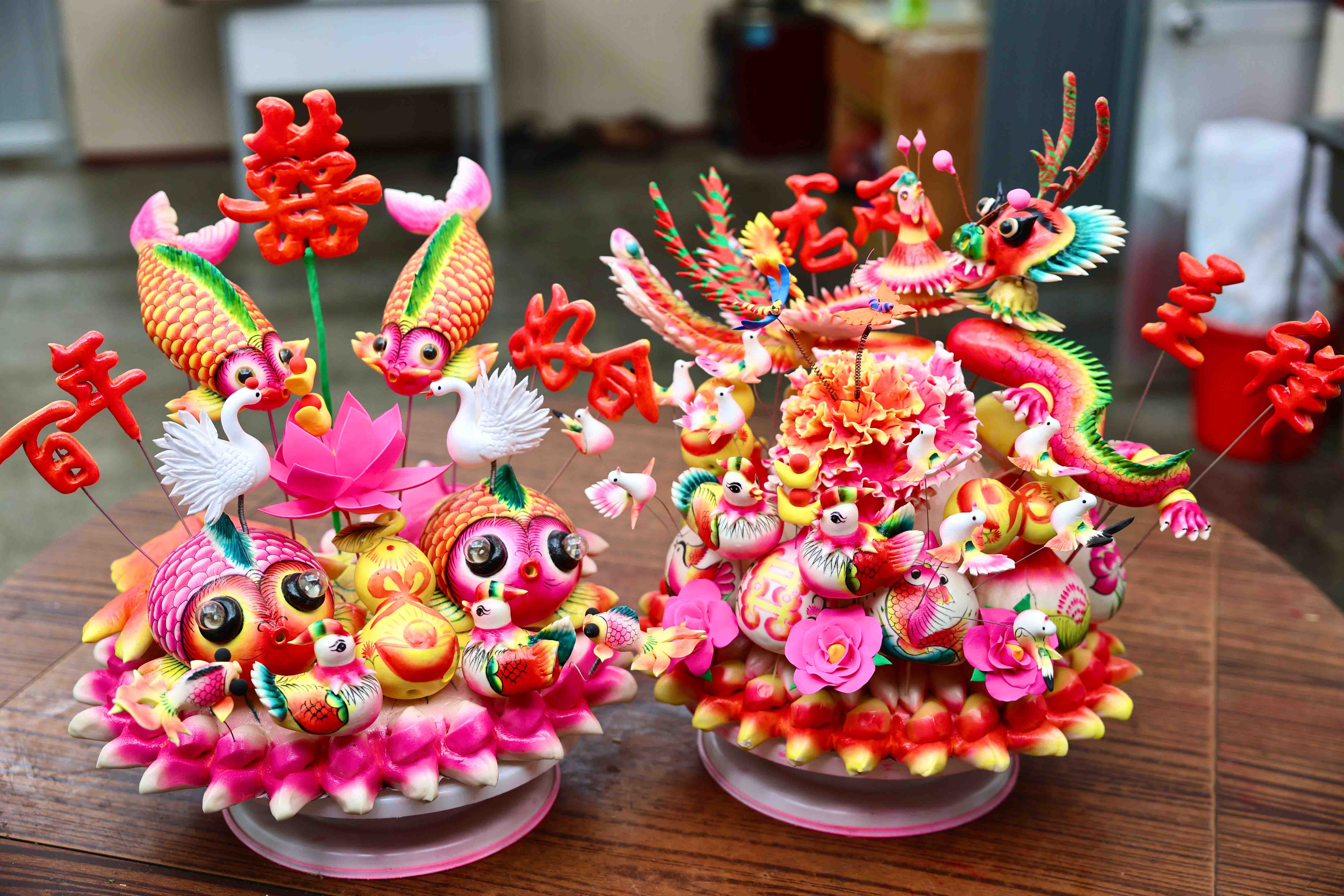
Photo shows Jiaodong Huabobo, an intricately crafted style of steamed bun. (People's Daily Online/Liu Kaiyang)
The Spring Festival period is his busiest time of the year, with apprentices crowded around the workbench turning out gift boxes of various Huabobo varieties.
Lin has been making Huabobo since childhood, learning at his mother's side. Over the decades, his focus has been on striking the right balance between visual appeal and wholesome ingredients, adapting the craft to suit modern tastes without sacrificing its character. To that end, he established his studio, refining everything from design and flavor to materials and techniques.
After more than 30 years in the craft, he has developed over 100 varieties across seven product lines, served as a visiting professor at several universities, and trained more than 400 apprentices. His son, Lin Peng, is now carrying the tradition forward as a young inheritor.
Today, every Spring Festival sees the studio's shelves piled high with various intricately crafted steamed buns. Customers come in a steady stream, from locals stocking up on Spring Festival provisions to visitors making a special trip to experience the festival's authentic flavors.
As night fell over the Laole Mountain Scenic Area in Queshan county, Zhumadian city, central China's Henan Province, a molten iron fireworks show captivated visitors. Streams of scorching molten iron, reaching temperatures as high as 1,600 degrees Celsius, soared into the air, resembling a dazzling shower of stars. This remarkable performance is known as Queshan Tiehua, or Datiehua, which literally means spraying molten iron into the air.
In the Ming (1368-1644) and Qing (1644-1911) dynasties, local blacksmiths sprayed molten iron skyward to pray for a good harvest and favorable weather in the year ahead.
Over time, however, the traditional folk art fell into decline, and for nearly 30 years it was almost lost. Concerted efforts to revive it paid off in 2008, when Queshan Tiehua was recognized as a national intangible cultural heritage.
"The molten iron has to be handled by a human being, and the right temperature can only be judged through experience," said Yang Jianjun, a national-level representative inheritor of Queshan Tiehua. Since its listing, the folk art has attracted growing attention, with more people documenting and learning it.
The Laole Mountain Scenic Area now houses a dedicated facility for preserving and passing down Queshan Tiehua, available free of charge to Queshan Tiehua performance troupes for training and rehearsals. Queshan county has also drawn up a work plan for preserving its intangible cultural heritage, including Queshan Tiehua.
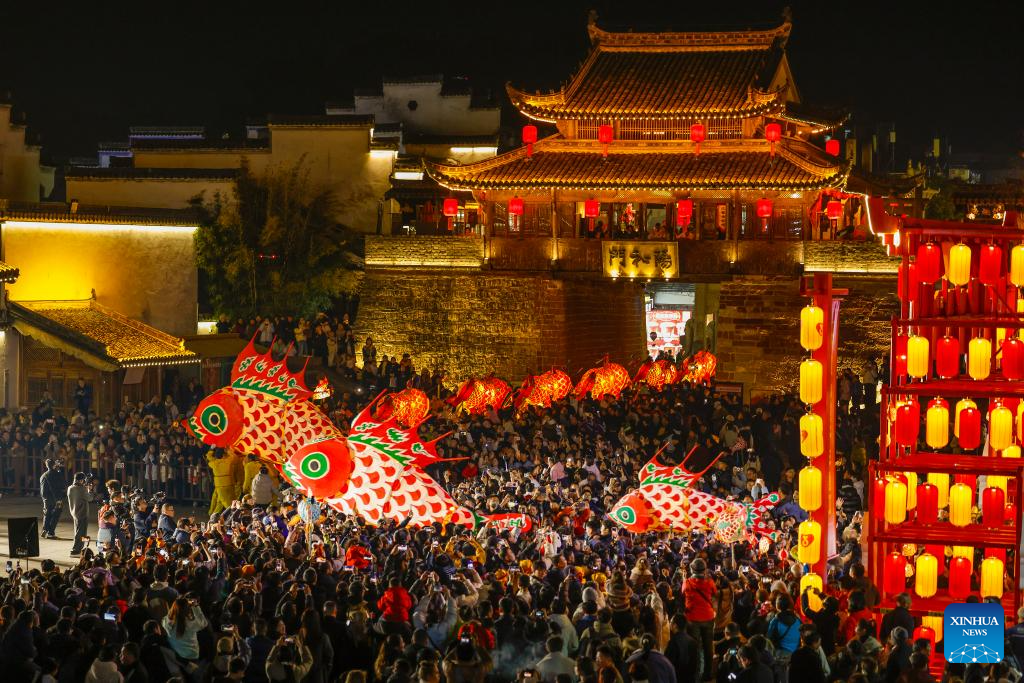
People watch a fish-shaped lanterns performance in Shexian county, Huangshan city of east China's Anhui Province, Feb. 4, 2026. (Xinhua/Shi Yalei)
Fish-shaped lantern parades drew crowds of tourists in Shexian county, Huangshan, east China's Anhui Province, during the 2026 Spring Festival.
The parade featuring fish-shaped lanterns is one of the best-preserved folk traditions in the Huizhou region, now mostly concentrated in Huangshan. The custom of holding fish-shaped lantern parades in the first lunar month to pray for blessings has been practiced in some villages of the region for more than 600 years and remains very much alive today, having branched into several local variants over time.
Among the many regional variations, those made in Wangmantian village, Xitou town, Shexian county, stand in a class of their own. In 2022, the Wangmantian fish-shaped lantern was listed as a provincial-level intangible cultural heritage.
Today, fish-shaped lantern parades in many parts of the region begin with the Spring Festival and have become a regular fixture of local cultural life, carrying with them the age-old wish for national prosperity and people's well-being.
Wang Huawu, a county-level representative inheritor of the craft born in 1982 in Wangmantian village, first learned to make fish-shaped lanterns as a teenager and has been at it ever since.
In recent years, as Wangmantian fish-shaped lanterns have gained popularity, lanterns of all sizes have found a ready market as festive gifts. "Orders keep coming in. More than 50 villagers are now making fish-shaped lanterns, and their average annual income from the craft can reach around 100,000 yuan ($14,600) per person," said Wang Huanxin, a village resident.
Shexian county has moved to capitalize on this momentum, pairing fish-shaped lantern displays with live performances to continuously enrich its cultural tourism offerings. Since 2025, the county has built a distinctive fish-shaped lantern brand and staged more than 300 fish-shaped lantern performances and parades, drawing over 10 million tourists.
During this year's Spring Festival, the Yingge dance, or "dance to the hero's song," a traditional folk dance that originated in the Chaoshan region of south China's Guangdong Province, was staged in several places across Shantou city.
Chaoyang district's Yingge dance, a unique art form combining dance, martial arts and drama, is a national-level intangible cultural heritage with a history of more than 1,000 years.
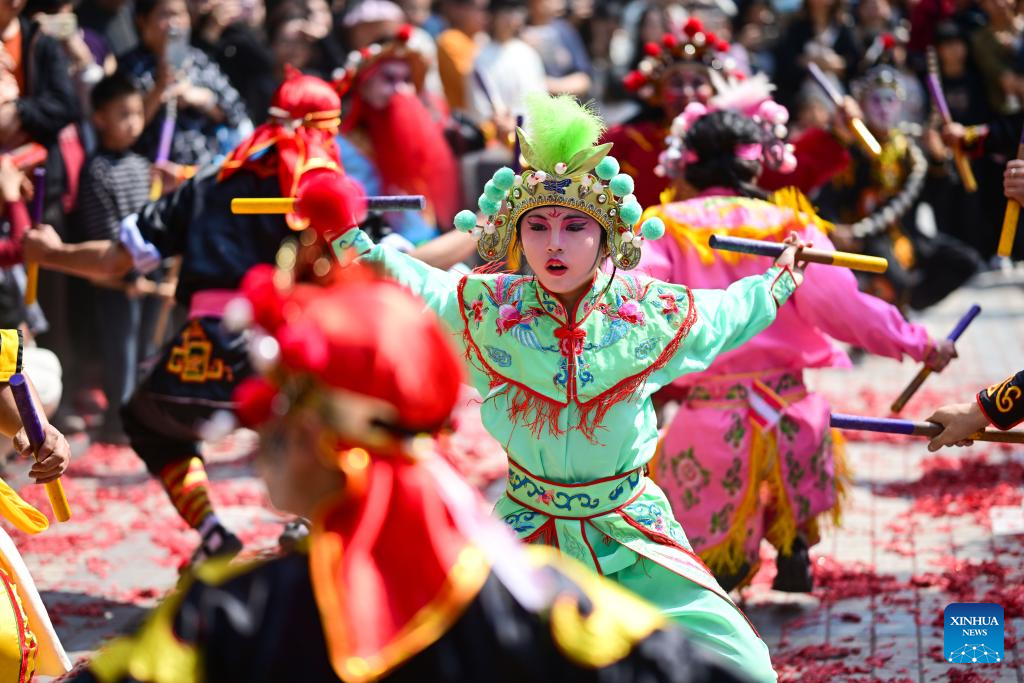
Artists perform Yingge dance in Puning, south China's Guangdong Province, Feb. 22, 2026. (Xinhua/Chen Yehua)
Zheng Haobin, born in 2003, is the head of the Taoyuan Yingge Dance Troupe in Chaoyang district, Shantou. He joined the century-old troupe at the age of 9 and became its youngest-ever head at 18.
In 2022, Zheng put forward the bold idea of forming an all-female Yingge team. In April 2025, the troupe traveled to the United Arab Emirates for a cultural exchange, sparking widespread enthusiasm for Yingge dance there.
To take Yingge dance to the world, Chaoyang district has adopted a two-pronged approach. It sends coaches to Malaysia and other countries to teach the art form and has helped establish seven overseas Yingge teams, while also hosting training programs for international students who come to Shantou to learn.
"We are now working hard to develop a complex themed on Yingge dance, so that visitors from elsewhere can fully immerse themselves in Yingge culture," said Ma Chuangzhou, director of the culture, radio, television, tourism and sports bureau of Chaoyang district. The complex, located in Tongyu town, has already become a popular destination in Shantou.
To further promote the development of Yingge talent, Chaoyang district has issued policy documents providing support for intangible cultural heritage inheritors and bases for passing down Yingge dance. The district now boasts more than 130 Yingge teams and 48 representative inheritors at various levels.
【编辑:董丽娜】
文章、图片版权归原作者所有,如有侵权请联系删除