







A 3,000-year-old glimpse into China's Bronze Age technological prowess
2026-09-20 10:43:27 来源:Xinhua
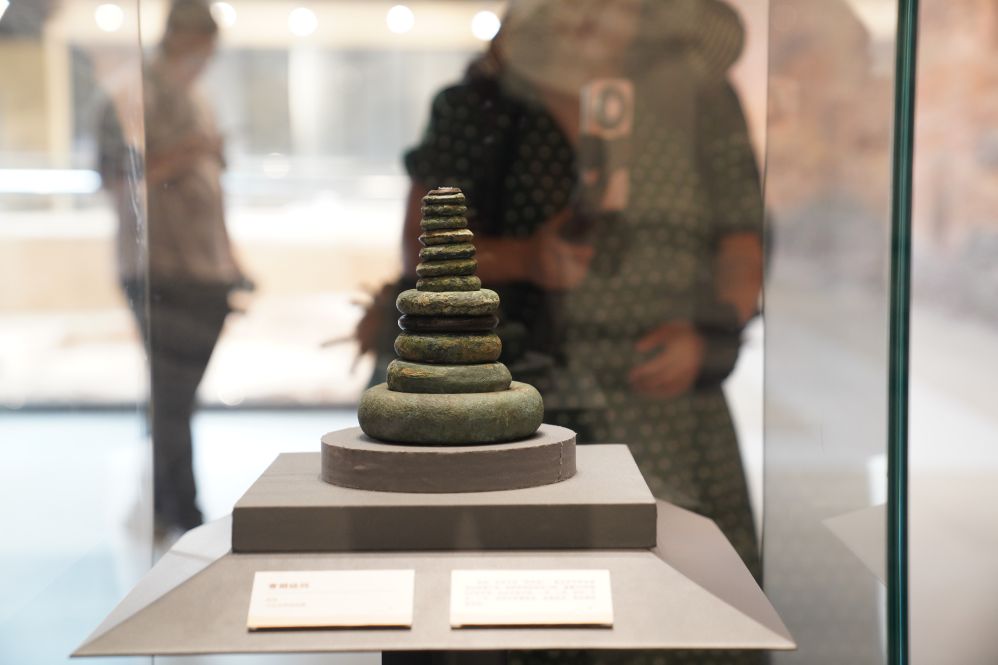
This photo taken on Sept. 15, 2026 shows a bronze weight from the Warring States Period (475 BC-221 BC) displayed at the museum of the Tonglushan ancient copper mining site in Daye City of central China's Hubei Province. (Xinhua/Lu Jinbo)
China is famous for its ancient inventions: papermaking, printing, gunpowder and the compass. But there is far more to its technological legacy than these.
One notable achievement is the Tonglushan ancient copper mining site. More than 3,000 years ago, people in China were already mining and refining high-purity copper on a large scale at this site, a feat that put them some 2,000 years ahead of the rest of the world.
Located in Daye, Hubei Province in central China, this site has welcomed more than 20 million visitors since it opened in the 1980s, including tourists from Japan, the Republic of Korea, Europe and Africa.
It received official designation as a National Archaeological Site Park in 2025 and is now working toward UNESCO World Heritage status.
To further showcase China's ancient industrial achievements to international visitors, a large-screen presentation launched last year features English subtitles alongside Chinese ones, while the park has also opened an educational workshop for visitors from China and abroad.
"The site shows that China has long had the capacity to develop advanced technologies independently. It also strengthens our cultural confidence," said Chen Jiayi, a staff member at the site park.
In the 21st century, China has once again emerged as a major industrial and technological power -- home to the world's most comprehensive industrial systems and making rapid advances in areas ranging from new-energy vehicles and artificial intelligence to robotics, quantum technology, space exploration and marine science.
The Tonglushan site was discovered by chance during mining operations in 1973, and archaeological excavations found that mining and smelting activity there dates back at least to the early years of the Spring and Autumn Period (770 B.C.-476 B.C.).
"It confirms that China's Bronze Age civilization followed a complete and independent course of development," Chen said. "Archaeological comparisons show that the copper used in the Bianzhong of Marquis Yi of Zeng, a famous set of bronze chime bells, as well as many other bronze artifacts, came from Tonglushan."
Excavations have found that the ancient mine shafts and tunnels at the site total more than 8,000 meters in length, and over 400,000 tonnes of smelting slag have been unearthed so far.
Researchers estimate that between 80,000 and 120,000 tonnes of crude copper were produced there over the centuries, enough to cast about 48,000 sets of bronze bells comparable in scale to those of Marquis Yi of Zeng, or a far larger number of ritual vessels and weapons.
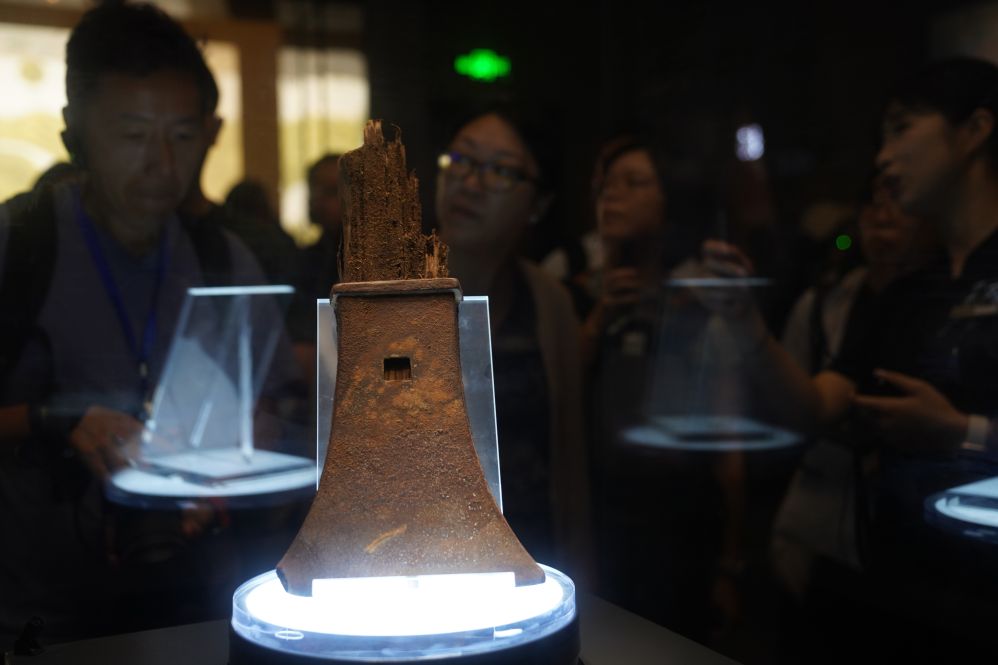
People view an exhibit at the museum of the Tonglushan ancient copper mining site in Daye City of central China's Hubei Province, Sept. 15, 2026. (Xinhua/Lu Jinbo)
"Bronze gave physical form to China's long-standing ritual and musical traditions, its social hierarchy, its way of life, and indeed its pluralistic yet unified civilization," Chen said.
Ancient craftsmen at this location had already mastered sophisticated mining and smelting techniques.
They used bellows-equipped shaft furnaces and two procedures, namely "oxidized ore to copper" and "sulphide ore to matte to copper," thereby precisely controlling furnace temperatures at around 1,200 degrees Celsius.
At the time, crude copper reached a purity of 93 percent, while the copper content in slag was just 0.7 percent, which is a level far ahead of the rest of the ancient world, with some techniques approaching near-modern standards.
Mining and metallurgical activity at Tonglushan never really stopped, and by the late 19th century it was home to what was then Asia's largest integrated iron and steel enterprise, while production further expanded after the founding of the People's Republic of China in 1949.
"Today, copper production here has moved into higher-value processing, serving fields such as new-energy vehicles, 5G communications and semiconductor chips," said Pan Xiaojin, mayor of Daye.
Daye has also expanded into a range of other industries, including intelligent connected new-energy vehicles, optoelectronic information, hydrogen energy, intelligent robotics, the low-altitude economy and green building materials.
"The spirit of craftsmanship, fueled by a drive to grow stronger and tempered through countless trials, continues to inspire us to create new wonders," Pan noted.
【编辑:董丽娜】
文章、图片版权归原作者所有,如有侵权请联系删除- 守正创新文气盛——写在2026北京文化论坛开幕之际
- AI赋能,文旅融合打开想象空间——2026中国文化旅游产业博览会观察
- 中国典籍如何“走进去”“走上去”?上外教授王有勇:要借帆出海、借智译介
- “营造”千年文脉:山东推动运河古建从“保得住”走向“活起来”
- “要么与AI同进化,要么被AI边缘化”——全省“人工智能+”工作推进现场会观察
- 全省“人工智能+”工作推进现场会在青岛举行 以更大力度实施“人工智能+”行动推进人工智能更好赋能千行百业 林武讲话 周乃翔主持 葛慧君刘强出席
- 北京・故宮博物院、27年版「故宮日暦」発表
- A 3,000-year-old glimpse into China's Bronze Age technological prowess
- Chinese Culture Day brings China closer to Australian students
- Chinese intangible cultural heritage exhibition in London showcases contemporary design
- 在AI“舞台”,遇见更“潮”非遗——从2026年服贸会看我国非遗保护传承新貌
- 守正创新文气盛——写在2026北京文化论坛开幕之际