







Traditional Reba Dance in SW China's Xizang beats its way onto bigger stage
2026-07-24 15:02:46 来源:People's Daily Online
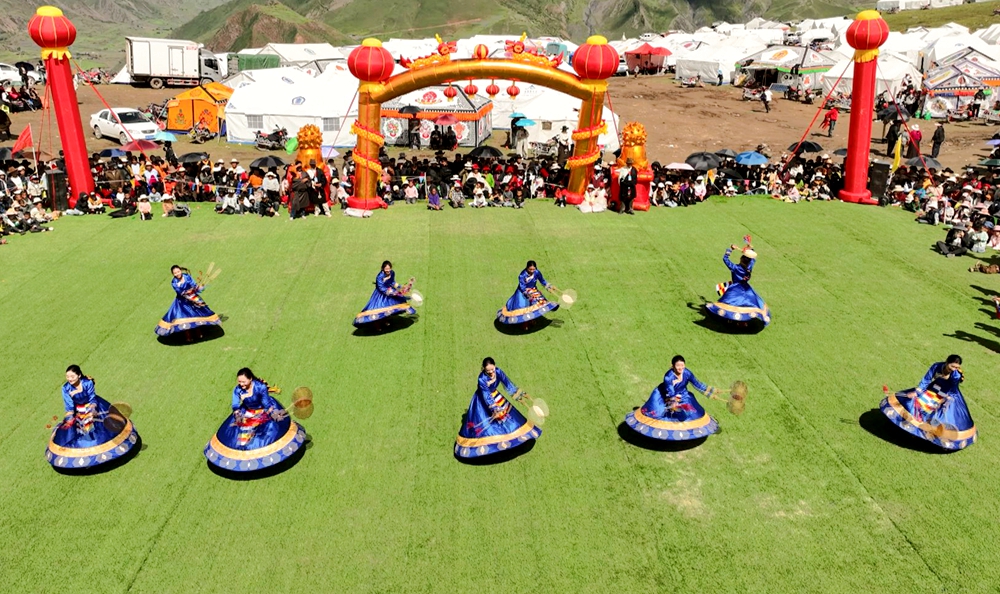
Reba Dance performers in traditional blue costumes perform on a grass field during a grassland cultural festival in Dengqen county, Qamdo city, southwest China's Xizang Autonomous Region. Reba Dance is a traditional drum dance in Xizang and also an item on China's list of national-level intangible cultural heritage. (Photo/Luo Yuxin)
On a grassy field in Wuba village of Dengqen county, Qamdo city, southwest China's Xizang Autonomous Region, 62-year-old Ani stood at the center of a formation, his arms stretched out like an eagle spreading its wings as he guided the other dancers.
As he called out the beats and set the rhythm, the drummers around him responded in sync.
Ani has practiced Reba Dance, a traditional drum dance in Xizang and an item on China's list of national-level intangible cultural heritage, for 52 years.
As the dance's seventh-generation inheritor in his family and a municipal-level representative inheritor of Reba Dance in Qamdo, Ani can both command the rhythm of an entire performance and precisely deliver the "nine-beat drum pattern," a highly challenging rhythmic sequence passed down for more than 900 years.
"Reba Dance is difficult because it requires both the physical strength and the agility of an acrobat and the precision of a drummer," Ani said while wiping sweat from his forehead.
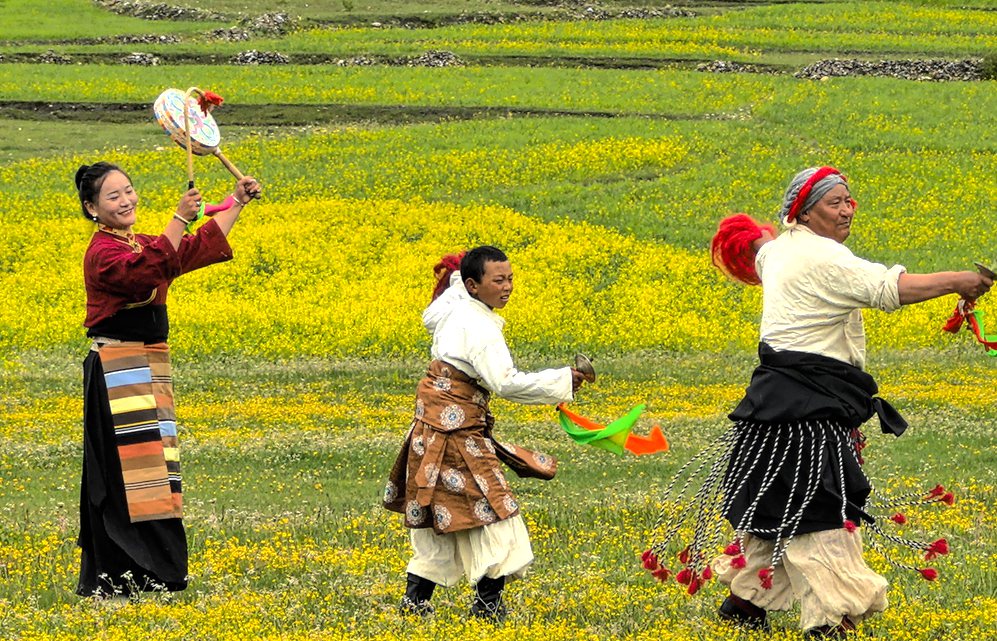
Ani (right), a 62-year-old municipal-level inheritor of Reba Dance, performs Reba Dance with young dancers on a grass field in Wuba village, Dengqen county, Qamdo city, southwest China's Xizang Autonomous Region. Reba Dance is a traditional drum dance in Xizang and also an item on China's list of national-level intangible cultural heritage. (Photo/Luo Yuxin)
Qiongbuzuhua Reba Dance, a distinctive school within the broader tradition, combines drumming, dance and acrobatics.
The "nine-beat drum pattern" in this school is particularly challenging, requiring performers to complete complex formations while spinning at high speed.
Ani, who previously served as the head of Wuba village, remains the mainstay of the local art troupe even after stepping down from the position.
He recalled that in the past, Reba Dance techniques were often passed down only within families, with customary rules such as "teaching only relatives" and "passing skills only to males" limiting their spread.
"The skills passed down by our ancestors must not disappear on my watch," Ani said.
He decided to open training to anyone willing to learn, and the decision has transformed the village.
Today, more than 200 of the village's farmers and herders can perform Reba Dance, and more than 40 skilled performers have been trained under Ani's guidance, enabling the traditional art to take root in the plateau village.
Among the younger generation is 34-year-old Sonam Palmo, an eighth-generation inheritor of Reba Dance.
People who know her once questioned her decision, thinking she should find a regular job instead of dancing.
"When I dance, I feel lighthearted and carefree," she said, adding that she finds self-worth and joy in the tradition.
Reba Dance has also moved beyond local celebrations. Once performed mainly for festivals in the village, it has become a cultural "calling card" that supports the integration of tourism and local culture.
The dance has been performed twice at the Great Hall of the People in Beijing and has gained wider exposure through online platforms.
To inject new vitality into the ancient art, Ani and his students have adopted a balanced approach: preserving traditional ways during local celebrations while introducing costumes and formations designed for modern audiences at public performances elsewhere.
"We need to make young people feel that this dance is cool and worth learning," Ani said.
For Wuba village, Reba Dance has become more than a traditional art form. It has become a vehicle for rural cultural revitalization, enriching residents' cultural lives while strengthening their confidence in their heritage.
An increasing number of local families now earn income through cultural tourism related to Reba Dance, and many young people are choosing to stay in their hometown rather than leave for more economically developed areas in search of work.
"As long as the drums keep beating and the tradition is passed on, Reba Dance will never disappear," Ani said.
【编辑:董丽娜】
文章、图片版权归原作者所有,如有侵权请联系删除