







尼山会客厅 | 金在荣:儒学视野中的中韩文化交流
2026-01-09 16:18:38
编者按:国外专家学者“齐鲁访学驻研计划”是为贯彻落实习近平主席提出的全球文明倡议,深化文明交流互鉴,由山东省委宣传部指导,尼山世界儒学中心、中国孔子基金会、山东大学共同发起,山东出版集团大力支持,立足山东儒家文化资源富集优势,架设国际人文交流合作桥梁的一项重要举措。
近日,“齐鲁访学驻研计划”访问学者、韩国西江大学宗教学系主任、韩国宗教学院院长金在荣接受中国孔子网“尼山会客厅”专访,分析儒学在中韩两国的传播演变与本土化发展,探讨传统儒学智慧对破解现代社会难题的现实价值,为深化两国人文交流、促进文明互鉴提供了独特视角。
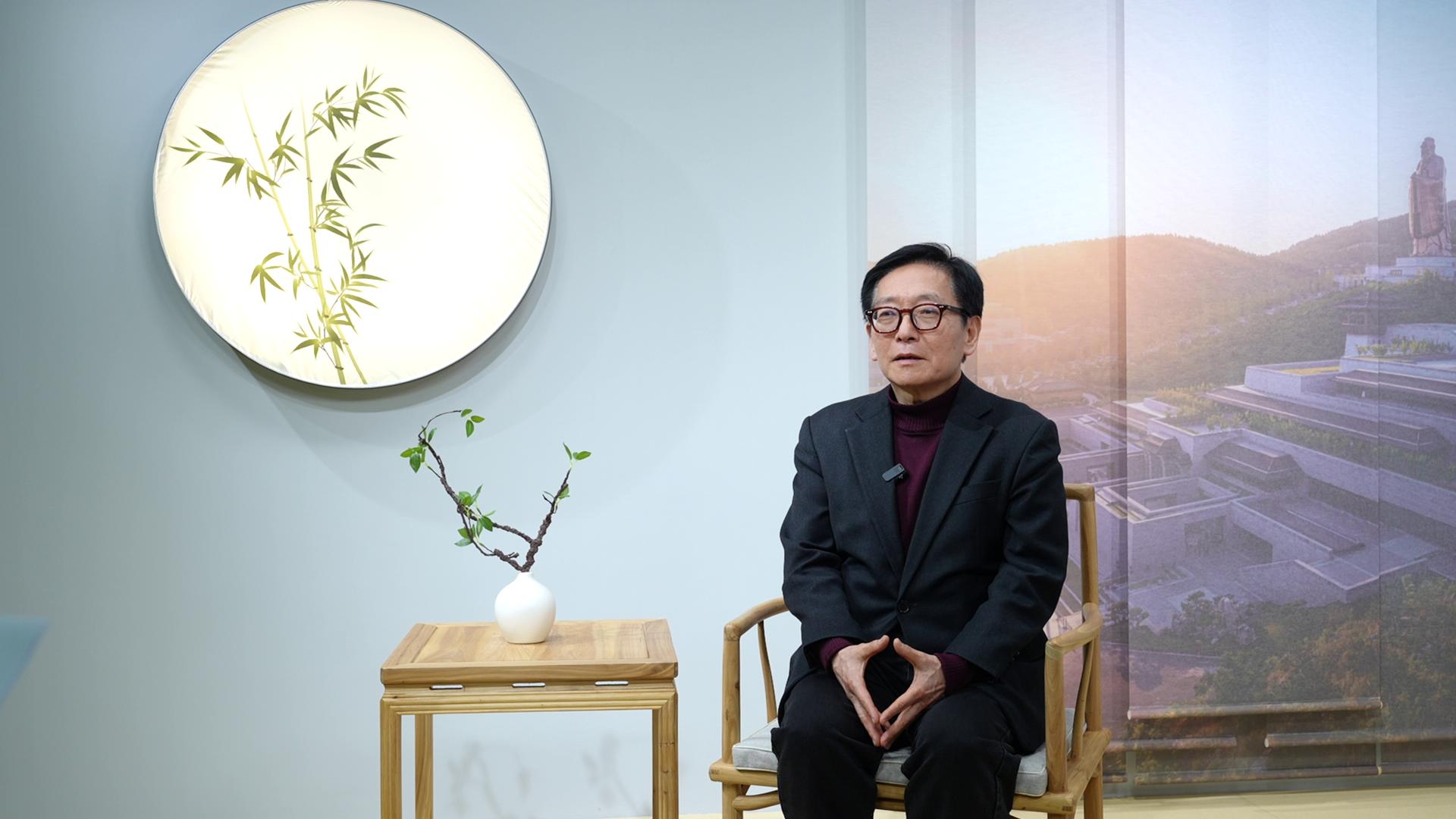
Q:Professor Kim, as a visiting scholar of the Qilu Visiting and Research Residency Program, what experiences left a deep impression on you during your stay in Shandong,the birthplace of Confucianism?
中国孔子网:作为“齐鲁访学驻研计划”访问学者,您在儒学发源地山东访学期间,有哪些经历给您留下了深刻的印象?
A:First of all,I would like to say thanks for this program. Personally,it is a very great honor for me to understand Confucianism in its home place. Before I came to China, my understanding of the nation was mostly derived from Western viewpoints.As soon as I came to the Shandong area,then I find that Confucianism is not dead. Confucianism is really a living spiritual tradition. It is not some sort of conceptual speculative tradition but an everyday life tradition. So, I felt that it is interspersed in everyday way of life in Shandong and beyond in China. So it really strikingly reminds me about the spiritual activities of human life in our history.
金在荣:首先,我想对这个项目表示感谢。对我个人来说,能够在儒家思想的故乡了解儒学是一种莫大的荣幸。我在没来到中国之前,对中国的了解大多来自西方视角,来到山东后,发现儒家思想并没有消亡,儒家是真正活着的精神传统。这不是某种概念性思辨性的传统,而是日常生活的传统,渗透于山东人以及其他中国人的日常生活方式中。这让我深刻地感受到了历史上人类的精神生活世界。
Q:Have these experiences in China inspared any of your new reflections regarding the inheritance and development of Confucianism in different cultural context?
中国孔子网:这些经历是否让您对儒学在不同文化中的传承与发展有了新的思考?
A:I think so. It is always relevant to understand more profoundly the nuance of the different countries'cultural context. It reminds me all the time to reflect upon the way how to struggle to become human in each different cultural context. So Confucianism is really telling me a humane way of attitude,a humane way of feeling,a humane way of the behavior,namely how to become seriously authentically human to others. So it really touches me in many ways since I came here.
金在荣:是的,这关系到更深刻理解不同国家的文化背景,它一直在提醒我思考如何努力做好一个真正的人。儒家思想实际上是在教给我人文的态度,人文的情感和人文的行为方式,即对于他人来说我们如何认真做人,真正做人。所以自从来到这里之后,方方面面真的很打动我。
Q:During his recent visit to China, President Lee Jae-myung mentioned the need to deepen China-South Korea people-to-people exchanges. As an important platform for Shandong to promote international exchange of Confucian culture, the Qilu Visiting Research Program has already attracted the participation of sinologists from many countries. What value do you believe this program holds for fostering in-depth cooperation between the Confucian studies communities of China and South Korea?
中国孔子网:近期韩国总统李在明访华时提到要深化中韩人文交流,而“齐鲁访学驻研计划”作为山东推动儒家文化国际交流的重要载体,已吸引多国汉学家参与。您认为该项目对促进中韩儒学研究界的深度合作有哪些价值?
A:I am very,very glad to hear that Korean President Lee Jae-myung was invited to your countriy. I find that President Xi Jinping and President Lee Jae-myung,they seem to show very,very timely,a concern or harmonious inner spirit on how the East Asian cultures to be unified, and also to be suggesting very,very harmonized values and many other ways. So in this sense,I think that the Qilu educational or research program makes the scholars think about how to let our common human culture, you know, the way of life, to be further academically studied or researched.Academically,I think this program is very important. And also it is very,very important how to meet deeply among the East Asian regions. How do we meet not superficially,but more deeply engage each other,how to meet the emotional inner bonding,how to meet culturally, bonding together deeply. Especially the Qilu Vist and residence Program is providing us a new platform how to breakthrough contemporary superficial encounters of humanity,more authentically engaging with the deeper sensibility of our humanity, together moving forward in the current global restless situation.
金在荣:我非常高兴地得知韩国总统李在明被邀请访华,我发现习近平主席和李在明总统双方都非常适时地表达了同样的关注,或者说一种内在和谐的思想,提出了以和谐的价值观来团结东亚地区间文化的建议,以及很多其他方面的建议。所以从这个意义上来说,我觉得“齐鲁访学驻研计划”这个项目,让学者们去思考如何让我们共同的人类文化、共同的生活方式得到进一步研究。所以从学术层面来说,我认为这个项目非常重要,这个项目让我们学者思考东亚地区之间该如何深入的面对彼此,如何不再是表面的接触,而是深入的结合。我们该如何真正满足情感上的内在联系、文化上的互相联结,尤其是“齐鲁访学驻研计划”正在为我们提供一种新的方式,从当代人类肤浅的邂逅中寻求突破,更深入的参与到人类更深层次的情感中,并在风云诡谲的全球环境中携手前进。
Q:Confucianism has a profound foundation of inheritance in Korean society. From your research perspective, what unique localized characteristics has Confucianism formed during its dissemination in Korea? How do these characteristics influence Korean people’s daily ethics and their concepts of social governance?
中国孔子网:儒学在韩国社会有着深厚的传承基础,从您的研究视角来看,儒学在韩国的传播过程中形成了哪些独特的本土特色?这些特色如何影响韩国人的日常伦理与社会治理观念?
A:In Korea,Confucianism is really every way of life-related. So whenever you go to any so-called cultural traditions in Korea,you can find out all the time Confucian framework and you can also find out today, in any way of life you can see that point very wel. For example,in Korean Christianity,when you go to the church,you can find out a very Confucianized version of Christianity.When you go to the Buddhist temple,you can also find out a very Confucianized version of Buddhism and Buddhist temples. And also if you go to the other spiritual traditions or non- religious secular traditions,you can find out that kind of living framework.Confucian framework has been still very,very alive in contemporary Korean way of life.Without understanding this framework,it is almost impossible for us to understand the Korean way of life. How Koreans in cultural or social settings engage with their attitude to the world,to themselves,to others. So in this sense,Confucianism is really one of the key backbones for the constituency of the Korean way of life.
金在荣:在韩国,儒家思想无论从哪方面来说都与日常生活息息相关。韩国的任何文化传统,都可以看到儒家思想的框架,在当代韩国的任何生活方式中,也能清楚地看到这一点。例如,当你去韩国基督教会时,去教堂时,你会发现儒家化的基督教版本和儒家基督徒。当你去佛寺的时候,你也可以看到非常儒家化的佛寺和佛教徒。如果你去看韩国的其他精神传统,或者非宗教的世俗传统,你也能发现这种生活体系,这意味着儒家的框架体系在韩国的生活方式中仍然非常活跃。这说明如果我们不理解这种儒家框架体系,就几乎不可能理解韩国人的生活方式,也不可能理解韩国人在其文化和社会背景下对待世界、对待自己、对待他人的态度。因此,从某种意义上说,儒家思想确实是构成韩国生活方式的重要支柱之一。
Q:How do these characteristics influence Korean people's daily ethics and their concepts of social governance?
中国孔子网:您认为这些特点对韩国人的日常伦理和社会治理观念有何影响?
A:It is always emphasizing not only on the individual attitude to others,but those beyond that one. How does the individual's attitude toward the community,toward the family,toward the government?It is always a Confucian ethos that is playing the profound role for the social governance,social ethics, to be maintained in Korean society.
金在荣:儒家思想不仅重视个人对他人的态度,还重视个人对社会、对家庭、对政府的态度。在社会治理和社会伦理中,儒家思想一直扮演着重要的角色,保留了很多儒家精神特质。
Q:In your view,as a shared cultural foundation between China and South Korea,what unique role can Confucianism play in advancing the people-to-people exchanges between the two countries?
中国孔子网:在您看来,作为中韩两国共同的文化基础,儒家思想在促进两国人民交流方面可以发挥怎样的独特作用?
A:This is an excellent question,I think if you go to China as well as Korea,you can find out a lot in common in cultural settings relating to Confucius,and those of Confucianism. Confucius is not only your biological ancestor,but the cultural, and many other ways. To Koreans as well as in our neighboring countries, Confucius is also a cultural ancestor,even though he is not a Korean,he is not a Vietnamese,he is not a Japanese,he is still regarded as a cultural ancestor,whom Koreans followed with his spirit. In that sense,this feature is very similar to the Abraham religions or Abraham spirituality. For example,in Christianity,Islam and also Judaism. Abraham is the key common ancestor to their followers. He is really the biological or the physical ancestor to the Jews , but to Christians,he is a cultural ancestor,spiritual ancestor,something like that way. Confucius is not a Korean,but he is culturally something like the ancestor. That's why the Koreans love Confucius and his spirit and his social ethical system。
金在荣:这是一个很好的问题,我认为研究中国和韩国时,会在文化层面找到很多共同点,都与孔子和儒家思想有关。孔子是你们的先祖,不仅是生理的先祖,还是文化的先祖,他也是其他很多方面的先祖。对韩国人以及其他邻国来说,孔子是文化上的先祖,虽然孔子不是韩国人,不是越南人,不是日本人,但他仍被当作一位文化先祖,这使得韩国人追随孔子的思想。在这个意义上,孔子的这一特征非常类似于亚伯拉罕。对于犹太民族来说,亚伯拉罕是全体犹太人至关重要的共同先祖,是他们生物性或生理性的祖先。但对于广大基督徒来说,亚伯拉罕是一位文化先祖,精神先祖。孔子不是韩国人,但他像是一位文化先祖。这就是为什么韩国人爱戴孔子,以及他的精神思想和社会伦理体系。
Q:The China-South Korea Confucianism Conference has been successfully held 12 times. In your opinion, what respective strengths do China and South Korea possess in the field of Confucian studies?From the perspective of the East Asian Confucian cultural circle, how can the academic communities of the two countries jointly explore the modern value of Confucianism to address common global challenges?
中国孔子网:中韩儒学大会已成功举办12届。您认为中韩两国在儒学研究领域各自具备哪些优势?从东亚儒学文化圈的视野角来看,两国学界如何共同挖掘儒学的现代价值以应对全球性挑战?
A:That is also very interesting and very good questions,but I really want to suggest something more than the encountering conferences among universities in China and Korea. According to my limited understanding of the China and the Korean Confucian studies program,it seems to be exclusively focused on specific university's initiative exchange programs,especially in the case of Korea. More broad exchange programs and conferences should be suggested, especially those for the expansion of the global exchange of the Confucian studies should be cultivated for the future collaboration. For example,more universities should be further connected to Chinese-Korean studies program of Confucianism.In so doing, it should be more spreading, not only the one specific area,one specific concern,one specific university but more than that mono level,especially not simply the philosophy-focused studies or theoretical-focused studies or the literature-focused studies. Maybe applied humanities, applied social sciences in relation to Confusionism should be exchanged in the program furthermore. For example, tourism studies, I think that it is a very emerging important issue in our common humane network building of the East Asian regions in terms of Confucius and also his spirituality issues. If it would be more deeply cultivated,I think that a profound new horizon will come up in terms of the tourism studies,not simply the business-oriented studies,but to the far more human-oriented concern for the cultural establishment of East Asia.
金在荣:这也是非常有趣非常好的问题。根据我对中国和韩国儒学研究项目的有限了解,这个会议是专门针对大学的交流项目,尤其是在韩国。我建议举办更广泛的会议和交流项目,尤其是旨在扩大全球范围内的儒学研究交流和未来合作的项目。例如,更多的大学应该进一步与儒学的中韩研究项目联系起来,这样做就会得到更好的拓展,不仅仅是一个特定的领域,一个特定的关注点,一所特定的大学,不再是单一的层面,不再是单纯的聚焦哲学的研究,或聚焦理论的研究,或聚焦文献的研究,也可以是与儒学有关的人文应用研究或应用社会科学研究等更多的项目交流。比如旅游研究,这是我们在东亚地区共同人文网络建设中非常重要的课题,可以从旅游研究角度研究孔子及其思想精髓。如果更深入地培养这些研究方向,我认为旅游研究将迎来全新的发展前景,不仅仅局限以商业为导向的研究,而是升华到人文关怀的东亚文化建设层面。
Q:In history, South Korea intergrated Confucianism its native family tradition as well as the examination and official election system and you have formed such localized and characteristic platforms as the family rituals and the schools of confucianism in every urban and suburban area of South Korea. But in China,things are different because China has undergone the combination of Confucianism and Marxism and also witnessed the creative development of this combination. So what's your opinion of this two different development approaches, although they stem from the same origin?
中国孔子网:韩国历史上将儒学与本土宗族制度、科举体系结合,形成了“家礼”“乡校”等特色载体;中国则在近现代经历了儒学与马克思主义的融合创新。您如何看待这种“同源异流”的发展路径?
A:As you know that in Korea,Confucianism came to Korea through China originally in 4th century,but the Neo-Confucianism came to Korea in the 14th century. So almost prior to the modernization,Confucianism had been playing the role in a Korean way of life almost 500 years. After modernization,still Confucianism has been functioning in Korean way of life. So the Joseon Dynasty way of life has not been going away.It is still engraved in our Korean psyche in many ways. So still you can find out a lot of Confucianism in a relationship between parents and the children, and also among the brothers and sisters, and also friends, and also the relationship between the civilians and the politicians, and also many many other ways. So in this sense,Confucianism is still very,very living in Korean in a way of life. Of course we have also separate independent school of the Confucian transmitted educational system,so called the“seowon”. But compared to the situation of the Joseon Dynasty period,it is not very spreading at the moment,but we have still several living seowon traditions in Korea. Though numbers are very small, we cannot deny that in public educational system, directly or indirectly, the Confucian-oriented educational spirit has been still alive.
金在荣:儒家思想最初是在4世纪从中国传到韩国的,但新儒学(宋明理学)是在14世纪传到韩国的。所以几乎在现代化之前,儒家思想一直在韩国人的生活方式中扮演着重要角色,发挥了500年的作用。在现代化之后,儒家思想仍然存在于韩国人的生活方式中。所以朝鲜王朝时代的生活方式一直没有消失。它仍然在许多方面铭刻在我们韩国人的心灵中。在父母子女关系中,兄弟姐妹关系中,民众与政治家关系中,以及很多其他关系中,依然可以发现儒家印记。儒家思想在韩国还是非常活跃的一种生活方式。我们还把儒学教育从学校教育体系中独立出来,建立乡校体系。虽然与朝鲜王朝时期相比,乡校目前并不是那么普遍,但仍有几所活跃的乡校。尽管乡校数量很少,但不可否认,在公共教育体系中,直接或间接地,以儒家思想为主导的教育精神仍然存在。
And also in terms of the politics,when you do not understand the Confucian sensibility,Confucian inner values,I don't think that even the diplomatic understanding of one's own country and those other countries,we cannot understand it properly。So in the sense, as I mentioned, Confucianism is a sort of a backbone or the framework for Korean way of life to be formed,to be closed,to be transformed。
在政治方面,我认为如果不理解儒家的情感、儒家的内在价值观,就不能够正确理解自己的国家和其他国家,哪怕只是外交性的肤浅理解。所以在这个意义上,儒家思想是韩国生活方式之所以形成、之所以闭环、之所以转变的一种支柱或框架。
So in that sense,I think many a secular ideology has been also engraved in terms of Confucianism, in a spirit or Confucian way of inner life. In that sense,I think according to my limited understanding, China attempts to show that Confucianism goes very well with the authentic spirit of Marxism and also Socialism, because the humane spirit of Confucianism is not against so-called political ideologies if humanity would be respected. It is very,very engraved mutually,so win-win. So within the framework of Confucianism,Marxism can be more flourishing, and Marxism can be more spiritually engraved in 21st century way of life.
所以从这个意义上说,我认为许多世俗的意识形态也被刻上儒家或儒家精神的内在生活印记。根据我对中国的有限了解,儒家思想与马克思主义和社会主义的真正精神非常契合,因为儒家的人文思想并不反对所谓的政治意识形态。儒家思想与马克思主义互相打上对方的印记,这是一种双赢。因此,借用儒家的框架体系,马克思主义可以更加繁荣,而21世纪的马克思主义也可以带有更多儒家精神的印记。
Q:During the dissemination of Confucianism in both China and in South Korea, the core concepts such as benevolence,ritual propriety and other things are widely spread and shared, but in the concrete course of practice,there also have developed some difference in understanding and in practice. What do you think of this difference based on their common ground?
中国孔子网:儒学在中韩两国的传播过程中,既共享“仁”“礼”等核心概念,也在具体实践中衍生出差异。您如何看待这种“共性中的个性”?
A:I think that is also a very important question. Generally, benevolence and the propriety and also the other issues, seems to be quite the same as the Chinese way of perception of those two or three things and those Korean way of the perception. But how they have been appropriated in their local way of life,in the localized context. So I think, according to my understanding,a Chinese way or concern of the benevolence seems to be very deeply engraved, quite in a long reflection in the history of China. Koreans also have a lot of concerns about long reflections, about the benevolence in Korean history.Due to this reason, both conturies seem to show broader empathetic understanding of others. For example, even though we do not talk much about each other,but we know what others are thinking,what others are feeling more attentively. So we have already concerned or taken care of in other people's thinking,other people's feeling,other people's behavior. So I think this is a very,very important commonality between the Koreans and also the Chinese. Of course there would be difference in its process in each context, I do not think there are fundamental differences between them. So I think still it is a very,very cultural bonding arena for Korea and China come together.
金在荣:我认为这也是非常重要的问题。“仁”“礼”等方面的问题,中国人与韩国人对此的认知非常相似,但这些概念是如何被用于当地的生活方式,适用于本地化的背景呢?根据我的理解,中国人对“仁”的关注带有中国式的印记,在中国的历史上似乎有对于“仁”的非常长久的思考。韩国人在历史上也对“仁”进行过长久思考。由于这个原因,中国人和韩国人都表现出对他人的宽广的共情和理解。比如,尽管我们彼此谈得不多,但我们贴心的知道别人在想什么,别人的感受是什么,所以我们已经关注或照顾了别人的思想、感受、行为。我认为这是韩国人和中国人之间非常重要的共同点。当然在具体实践“仁”的过程中,中韩之间有区别,但我不认为有本质不同。所以我认为这是能够让韩国和中国走到一起的非常具有文化性联结的地带。
Q:What do you think that, from the perspective of comparative study of Confucianism, the two countries’ scholars can make a dialogue so as to tell the difference and also to recognize the same ground and to reach a consensus,so as to contribute together to the mutal learning among global civilizations with our Oriental paradigm?
中国孔子网:若以“比较儒学”为视角,您认为两国学者如何通过对话厘清差异、提炼共识,进而为全球文明互鉴提供更丰富的“东方样本”?
A:I think that as we have already talked a lot about the exchange, academic exchanges between South Korea and China, according to my limited research,quite a big frame has been quite well developed among many scholars. But in the current time, we should think more about concrete research. It's time for us to be more sensitively concerned about very deep research about the specific arena. For example,in human activities,smiling is very important and also in human activities,crying is very important,but how Confucius has expressed his crying in his life time. So how Confucius has expressed his silence? According to my research,nobody has concerned about any critical research about Confucius’ silence,Confucius crying. So it is really time to think more about new concrete researches on Confucius or Confucianism.
金在荣:我们已经谈了很多关于韩国与中国之间的学术交流。根据我有限的研究,众多学者已经构建了一个相当大的框架体系。但是目前,我们应当考虑一些更为具体的研究。现在是时候让我们更深入地关注特定领域的探索研究了。比如,在人类活动中,微笑是非常重要的,哭泣也是非常重要的,但孔子在一生中是如何表达他的哭泣,表达他的沉默呢?据我的研究,还没有人重点研究过。所以现在的确应该考虑对孔子本人和儒家思想做一些更具体的研究了。
When we talk from now on we have to be more specifically concerned about the critical psychological or spiritual research about the emotional expressions or the thinking expressions, for example,laughing,smiling, dance and hope,and also love and refusal experience . This kind of very specific inner values, specific emotional flowing should be newely researched. But until now,I think that we are very accustomed to meet conceptual speculative pictures about the Confucianism,but it's really time for us to be more differently engaging with Confucian values for the engagement with diverse contemporary issues.
今后我们的探讨,必须更具体地关注情感表达或思维表达的批判心理学或精神性研究,例如,大笑、微笑、手舞足蹈、希望、爱、拒绝等情感体验。这些非常具体的内在价值观,非常具体的情感流动,应该被给予全新的研究。但直到现在,我认为我们都只是习惯于对儒家思想进行概念思辨性的描绘,如今是时候结合种种现代课题,以不同的方式参与儒家的情感价值研究了。
So, for one example, on human issues, I think we should consider people like us in terms of more human-oriented dignity rather than the strict narrowness of human rights,I think that sensibility of human dignity should be more appropriated not only for the deep sense of the Confucian value but also for the formation of humane platform for the mutual understanding of our humanity in a global context.
所以,以人类问题为例,我认为应该更多从以人为本的人性尊严的角度,去考虑和我们一样的人,而不是只考虑严苛狭隘的人权问题,我认为人性尊严不仅应当用来思考儒家价值观的深层意义,也应当用来思考如何构建人文的载体,使我们在全球背景下能够互相理解我们的人性。
Q:Confucianism is not only an ethical philosophical system, but a whole lot of deep thinking about the harmony between human and the cosmos, and how we recognize the whole world and through this process that we also understand ourselves, and many things like this about the relationship between human and nature,between our recognition and practice. We are now under the global,environmental and biological crisis. The ever accelerating scientific and technological revolutions such as AI and gene editing and many more challenges have arised from this background. So do you think Confucianism can contribute to the construction of scientific and technological ethics and sustainable development with its unique oriental wisdom?
中国孔子网:儒学不仅是伦理哲学体系,其“天人合一”“格物致知”等思想还蕴含着对人与自然、认知与实践关系的深刻思考。在当今全球生态危机与科技革命(如人工智能、基因编辑)加速演进的背景下,您认为儒学能否为构建“科技伦理”或“可持续发展观”提供独特的东方智慧?
A:That is a verygood question and a very proper question in the age of the AI.I think that Confucius would suggest many insights! So in the sense I think that we have to seriously re-engage how Confucius listened to soundless music, in other words, how he perceived our world. What I mean is that Confucius is all the time concerning about disorder of Li(proriety). So that should be restored more properly, then all people, not only the people,but also the Tian(Heaven),not only the Tian,but also the all beings come together harmoniously. So I think in this sense, Confucius is very creative about how to restore in Li in the turbulences of his lifetime. That's why he really wants to let his students to restore about that aspect,even in his very,very hard times, tragedy period, he is always concerning about restoring order about Li. Metaphorically speaking,it tells explictly Confucius’ attitude to listen to the cosmic music,namely how to perceive the world. He really expected in our human world,the proper flowing of all beings coming together harmoniously and flowing on the basis of Li. So if we pay attention to the Confucius attitude towards that one,I think that even in the 21st issues about the ecological matters and also a lot of diplomatic difficulties. So if we pay attention,what is really losing in our contemporary society?So I think that is a very important insight for us to think about how to restore order through the sensibility of Li, which means still resonating in our contemporary way of life.
金在荣:在人工智能时代,这是一个非常恰当的问题。我认为孔子可以给我们很多好的建议!从某种意义上说,我们必须认真地重新思考孔子是如何倾听“无声之乐”的,换言之,他是如何去理解这个世界的。孔子一直在关注礼崩乐坏的问题,他认为应该恢复“礼乐”,这样一来,所有人,不仅是人,还有天,以及万物,都能和谐汇聚。从这个意义上来说,孔子是非常有创造性的,在他生活的动荡时代中致力于恢复秩序,这是他真正想让他的学生关注的方面。甚至在他非常艰难的时期,充满悲剧的时期,他依然关心礼乐秩序的恢复,这明确体现了孔子在聆听宇宙之乐时的态度,即他认知这个世界的态度,他真切希望人间万物能够顺着“礼”来和谐相处。所以我们应该关注一下孔子在这一点上的态度,关注一下21世纪的生态问题,以及诸多外交问题,思考当代社会正在失去什么,去思考如何通过礼乐的情感来恢复秩序,让礼乐仍然在我们的现代生活中产生共鸣。
【编辑:张晓芮】
文章、图片版权归原作者所有,如有侵权请联系删除- 尼山会客厅 | 金在荣:儒学视野中的中韩文化交流
- 深刻理解我国五年规划的作用机制和重要优势
- 深刻理解和把握“增强党的政治领导力”
- 文化滋润,善莫大焉
- “齐白石在山东”以艺术想象撬动文旅增量 一生未至山东,“隔空”搅热文旅
- 二〇二五,那些难忘的文化新图景
- 尼山会客厅 | 金在荣:儒学视野中的中韩文化交流
- 中国・西安で唐代墓を発見 西域特色の金銀器出土
- 中国浙江省の竹細工職人、無形文化遺産を「国潮」にアレンジ
- Homestays catalyzing rural and tourism growth in Huangshan
- Ancient bamboo slips emerge from silence through restoration
- Chinese couple turns 100,000 photos of Great Wall into a museum